
There's a particular kind of business writing that sounds impressive until you try to work out what it's actually saying.
You've probably encountered it. A company promises to deliver innovative, integrated solutions that optimise operational efficiency and facilitate sustainable growth. Every word sounds suitably professional. Yet after reading the sentence, you're no closer to understanding what the company actually does.
The problem isn't necessarily poor writing. It's the assumption that complicated language makes a business sound more credible.
It doesn't.
Whether you're writing a website, publishing a LinkedIn article or explaining a technical service, your audience needs to understand what you're telling them. If they have to reread every other sentence, look up unfamiliar terminology or work out what you're trying to sell, something has gone wrong.
Professional writing should communicate expertise, not make readers work to find it.
And there's an important distinction between simplifying your writing and simplifying the subject you're writing about.
Why Does Professional Writing Often Sound So Complicated?
Much of the problem comes from how we learn to communicate professionally.
At university, we're encouraged to demonstrate our understanding through academic language, technical terminology and detailed explanations. In the workplace, we adopt the vocabulary of our industries. Eventually, expressions that would confuse most people become perfectly ordinary to us.
There's nothing inherently wrong with that. Every profession has its own terminology, and sometimes a specialist term is the most accurate way to explain something.
The difficulty comes when we forget that our readers don't necessarily share our knowledge.
Consider a lawyer writing about corporate restructuring. Terms such as due diligence, shareholder resolution and beneficial ownership are familiar to someone working in corporate law.
To a business owner establishing their first company, however, those terms might require an explanation.
The lawyer understands the subject perfectly well. The business owner needs to understand what it means for their company.
Good professional writing connects the two.
The difference between expertise and sounding like an expert
Imagine visiting two accounting firms' websites.
The first promises:
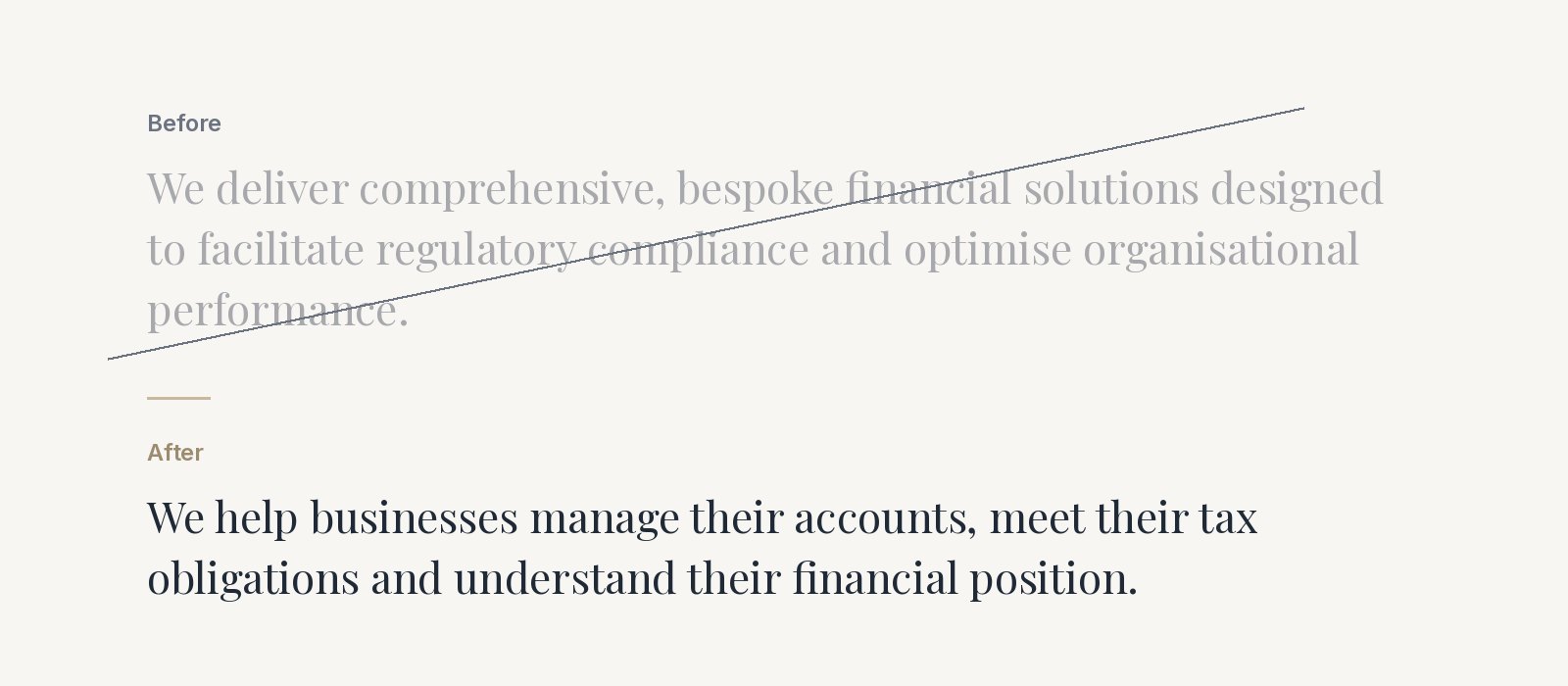
"We deliver comprehensive, bespoke financial solutions designed to facilitate regulatory compliance and optimise organisational performance."
The second says:
"We help businesses manage their accounts, meet their tax obligations and understand their financial position."
Both descriptions could refer to exactly the same services.
The first uses more sophisticated vocabulary. The second tells a prospective client what the business does.
Which description would help you decide whether the firm offers what you need?
This doesn't mean that every business should write informally or abandon technical terminology. A financial institution preparing a regulatory report has different communication requirements from an accountant explaining tax obligations to small business owners.
The appropriate level of complexity depends on who's reading.
The aim is to make the content as straightforward as its subject and audience allow.
What Happens When Your Audience Doesn't Understand Your Content?
A reader who doesn't understand your content has several options. They can reread it, look for an explanation elsewhere or simply leave.
None is particularly desirable when your content is supposed to generate enquiries, explain a service or establish your expertise.
Poor clarity can affect several aspects of your content's performance.
Readers struggle to find the information they need
People generally visit a business website because they want something.
They might need to understand a service, compare providers, resolve a problem or determine whether they're eligible for something.
If your content buries that information beneath lengthy introductions and unnecessarily complicated explanations, finding an answer becomes difficult.
A technically accurate article isn't particularly useful if readers can't locate or understand the information they came for.
Your expertise becomes harder to recognise
Businesses sometimes use complicated language because they believe it demonstrates authority.
Unfortunately, the opposite can happen.
A prospective client who doesn't understand your explanation has little basis for judging whether you understand their problem.
Explaining a complicated subject clearly gives readers an opportunity to recognise your knowledge.
This is particularly important for professional services, where clients often need assistance precisely because they lack specialist expertise.
Your content creates unnecessary friction
Imagine a prospective client reading about a service that could solve their problem.
They reach the end of the page without understanding what's included, whether they're eligible or what happens after making an enquiry.
They might contact you for clarification. They might also continue searching until they find another provider who explains things more clearly.
Your content should answer reasonable questions before readers have to ask them.
That doesn't mean publishing every technical detail. It means giving people enough relevant information to make an informed decision about what to do next.
How Do You Make Professional Writing Easier to Understand?
Improving readability doesn't require abandoning your professional voice or rewriting everything in conversational language.
It requires understanding your audience, organising information properly and making deliberate editorial decisions.
Here are six practical ways to approach it.
1. Write for the person reading, not the person approving
Before writing anything, establish who needs to understand it.
A technical article for experienced immigration lawyers will naturally contain different terminology and detail from a guide explaining visa options to someone considering their first international relocation.
Both can be professional. Both can be clear.
The mistake is treating them as though they're written for the same reader.
Ask yourself what your audience already knows, what they're trying to achieve and which information they need to make their next decision.
Then write accordingly.
If you're preparing content for a business, it's also worth distinguishing between the person approving the article and its intended audience. Internal reviewers may be comfortable with industry terminology that prospective clients have never encountered.
Your readers should determine how the content is written.
2. Explain what something means before discussing its complexities
Specialist subjects frequently require detailed explanations. However, introducing every technical consideration immediately can make an otherwise useful article difficult to follow.
Start by establishing the central concept.
For example, an article about Thailand's Board of Investment (BOI) could begin with a detailed examination of promotional categories, eligibility requirements and available incentives.
Alternatively, it could first explain that BOI promotion allows qualifying businesses to apply for certain tax and non-tax incentives, subject to their approved activities and applicable conditions.
Once readers understand what BOI promotion is and why it might be relevant, you can introduce the eligibility requirements and technical details.
You're not removing important information. You're presenting it in an order that helps people understand it.
3. Remove words that aren't doing anything
Business writing has an unfortunate tendency to accumulate unnecessary words.
Expressions such as "in order to", "with regard to" and "at this particular point in time" often make sentences longer without adding useful information.
Compare these examples:
| Instead of | Consider |
|---|---|
| In order to improve | To improve |
| At this point in time | Currently |
| We are in a position to provide | We can provide |
| In the event that | If |
| Utilise our services | Use our services |
These are examples rather than universal replacements. Sometimes a longer expression is appropriate because it conveys a specific meaning or suits the document's tone.
The important question is whether each word contributes something.
Read a sentence and remove anything unnecessary. If its meaning remains unchanged, you've probably improved it.
4. Keep technical terminology when it's necessary
Plain language doesn't mean eliminating every technical expression.
Sometimes replacing an established term with an everyday alternative introduces ambiguity or changes the meaning entirely.
Legal, financial and regulatory content requires particular care.
For example, tax residence has a specific meaning determined by the applicable jurisdiction and its rules. Replacing it with a casual reference to where someone lives could misrepresent those rules.
The solution is to retain necessary terminology and explain it.
Introduce the term, provide an accessible definition and establish why it matters to the reader.
Once you've explained it, you can generally use the correct terminology throughout the remaining article without repeatedly defining it.
The objective is understanding without sacrificing accuracy.
5. Organise your content around the reader's questions
Clear writing isn't exclusively about vocabulary or sentence length.
Structure is equally important.
An article can contain beautifully written paragraphs and still be difficult to understand if the information appears in the wrong order.
Consider what your audience needs to know first. Then identify which questions naturally follow.
For a professional services page, that might mean explaining what the service involves, who needs it, what the process looks like and what the reader should do next.
Use descriptive headings to separate those subjects.
Where appropriate, answer the question immediately before introducing supporting explanations.
This approach also supports search visibility. Clear headings and direct answers help search engines interpret your content and make it easier for readers to locate relevant information.
However, headings should reflect genuine questions and topics. Turning every paragraph into a keyword-heavy question rarely improves the reading experience.
6. Edit for understanding, not just grammar
A grammatically correct sentence isn't necessarily an effective sentence.
You can eliminate every spelling mistake, correct every punctuation error and still produce something that nobody understands.
Once you've finished editing for accuracy, read the article from your audience's perspective.
Can someone unfamiliar with the subject follow the explanation? Have you introduced terminology without defining it? Are you assuming readers understand something that hasn't been explained?
Pay particular attention to passages where several technical concepts appear together.
You may need to divide a paragraph, introduce an example or reorganise the explanation.
Reading your work aloud can also help identify unnecessarily long sentences and awkward phrasing.
A good editor does more than correct mistakes. They make sure the writing communicates what its author intended.
How Can You Tell Whether Your Content Is Easy to Understand?
One of the difficulties with professional writing is that familiarity can make problems difficult to recognise.
When you've spent years working in a particular industry, you might understand a sentence immediately without realising that someone outside your profession would struggle with it.
There are several ways to assess whether your content is communicating effectively.
Use readability tools as a guide
Readability tools can help identify complicated sentences, dense paragraphs and potentially difficult vocabulary.
Some useful options include:
- Hemingway Editor: highlights lengthy sentences, passive voice and other features that may make writing harder to read.
- Grammarly: provides suggestions relating to grammar, clarity, tone and sentence structure.
- Microsoft Word: includes readability statistics that can help you assess the complexity of a document.
These tools can be helpful during editing, particularly when you're working with a lengthy article or technical document.
However, a readability score isn't proof that your audience understands what you've written.
A short sentence containing three unfamiliar legal terms might receive a favourable readability score while remaining completely inaccessible to its intended reader.
Equally, a longer sentence may be necessary to explain a technical concept accurately.
Use readability tools to identify passages worth reviewing rather than treating their recommendations as instructions.
Ask someone outside your industry to read it
This is particularly useful when you're preparing content for non-specialists.
Give your article to someone who isn't familiar with the subject and ask them to explain its main points.
If they struggle to summarise a section, identify an important distinction or explain what happens next, revisit that part of the article.
You don't necessarily need a formal research exercise. Even one reader can identify assumptions you've overlooked.
For important commercial content, testing with several people who resemble your intended audience can provide more useful feedback.
Look at how readers interact with your content
Your website's analytics can provide additional information.
For example, you might examine whether visitors continue to relevant service pages, submit enquiries or interact with important calls to action.
You can also look at engagement patterns and use appropriately configured analytics tools to understand how people navigate individual pages.
However, these measurements require interpretation.
A visitor leaving a page doesn't automatically mean the content was confusing. They might have found exactly the answer they needed.
Similarly, a lengthy visit doesn't necessarily indicate engagement. Someone might be struggling to find a particular piece of information.
Consider analytics alongside actual reader feedback and your content's intended purpose.
The most useful question is whether readers understand enough to accomplish what brought them to the page.
Can AI Help Make Professional Writing Clearer?
Yes, provided you treat AI as an editing tool rather than allowing it to make every editorial decision.
AI writing tools can be particularly useful for identifying unnecessarily complicated sentences, suggesting alternative wording and highlighting passages that may require additional explanation.
For example, you could give ChatGPT a technical paragraph and ask it to identify terminology that a small business owner might not understand.
You could also ask it to suggest ways of reorganising an explanation without changing its meaning.
However, there's an important distinction between using AI to improve readability and asking it to rewrite an entire article in simpler language.
The latter can introduce problems, particularly when the content deals with specialist subjects.
The problem with automatically simplifying technical content
AI tools don't necessarily understand which details are legally, commercially or technically essential.
A sentence containing several qualifications might look unnecessarily complicated. Yet those qualifications could determine whether the statement is accurate.
Consider the difference between saying that a particular immigration programme allows applicants to obtain permanent residence and saying that it provides a route through which eligible applicants may apply for permanent residence, subject to specified conditions.
Those statements are not interchangeable.
An automated rewrite that removes the qualifications could create a misleading impression.
This is why professional editing requires subject knowledge and human judgement, particularly for legal, financial and regulatory content.
How to use ChatGPT to improve readability
Rather than asking AI to rewrite everything, give it a specific editorial task.
For example:
Example editing prompt
Review the following article for clarity and readability.

The intended audience is business owners who have limited knowledge of the subject.

Identify:
1. Sentences that are unnecessarily complicated.
2. Technical terminology that requires explanation.
3. Paragraphs that contain too many separate ideas.
4. Information that assumes prior knowledge.

Suggest improvements without changing the original meaning, removing essential qualifications or introducing new factual claims.

Explain why you recommend each change rather than automatically rewriting the entire article.
This gives you something considerably more useful than an automatically rewritten article: an editorial review that you can assess against your own knowledge of the subject.
You'll still need to check the suggestions, particularly where technical accuracy is important. Avoid uploading confidential client information or sensitive documents without appropriate authorisation and data-handling safeguards.
AI can help you identify potential problems. Deciding how to resolve them remains an editorial responsibility.
Does Clearer Writing Help SEO?
Clear writing and SEO serve different purposes, but they work well together.
Search engine optimisation helps people discover relevant content. Clear writing helps them understand what they've found.
Neither guarantees the other.
An exceptionally well-written article won't necessarily attract organic traffic if it doesn't address something people are searching for. Equally, an article that ranks for a relevant keyword isn't particularly valuable if readers struggle to understand it.
The aim is to satisfy both requirements.
Match your content to search intent
Before writing, establish what someone searching for your chosen topic actually wants to know.
For example, someone searching for information about company registration might want to understand the registration process, required documents, eligibility conditions or likely costs.
An article that spends most of its time discussing the history of company law probably won't address those immediate needs.
Answer the main question clearly, then introduce supporting information where it helps the reader.
This doesn't mean every article needs to be short. Complex subjects often require detailed explanations.
The important consideration is relevance.
Use descriptive headings and meaningful internal links
Your headings should help readers understand how the article is organised.
Where appropriate, they can also incorporate relevant search terms, provided those terms fit naturally.
Internal links serve a similar purpose. They allow readers to explore related subjects without forcing every article to explain everything.
For example, an article discussing the importance of clear professional writing could link to a separate guide about hiring a ghostwriter or developing an effective content strategy.
Those links should offer genuinely useful additional information.
Adding links or repeating keywords simply to satisfy an SEO checklist does little to improve the article itself.
Don't confuse readability with a ranking formula
There isn't a universal readability score that guarantees better Google rankings.
Search engines consider numerous signals when determining which pages to display. Reducing sentence length or achieving a particular reading-grade score doesn't automatically improve your position.
Instead, concentrate on publishing accurate, original content that answers relevant questions and provides a good reading experience.
SEO should help you make useful content discoverable, not dictate every sentence you write.
When Is Professional Editing Worth Considering?
Not every piece of writing requires a professional editor.
A straightforward internal announcement or routine business email might need little more than a careful proofread.
However, professional editing becomes more valuable when the content is commercially important, technically complicated or intended for an audience unfamiliar with the subject.
Consider a consultancy preparing a detailed explanation of its services.
The consultants understand their work, but they might struggle to describe it without relying on industry terminology. Their initial draft could be technically excellent while leaving prospective clients unsure about what the consultancy actually offers.
An experienced copywriter can help identify those communication problems, organise the information and present the business's expertise in language its intended audience understands.
For specialist subjects, the process should involve collaboration.
The writer brings editorial judgement and an understanding of the audience. The subject-matter expert checks that the content remains technically accurate.
The result should sound like the business, communicate its expertise and give readers the information they need.
Professional editing isn't about making every company sound the same. It's about helping each company communicate more effectively in its own voice.
Frequently Asked Questions About Clear Professional Writing
What are the main principles of clear professional writing?
Clear professional writing is accurate, relevant, appropriately structured and suited to its intended audience. It uses familiar language where possible, explains necessary technical terminology and presents information in an order that readers can follow. Every sentence should contribute to the intended message.
How can I make my writing sound professional without using complicated words?
Concentrate on accuracy, specificity and tone rather than sophisticated vocabulary. Explain what you mean directly, avoid unnecessary jargon and use examples when they help clarify complex information. Professionalism comes from communicating effectively, not choosing the longest available word.
What are the seven Cs of professional communication?
A commonly taught framework identifies seven principles: clarity, conciseness, concreteness, correctness, coherence, completeness and courtesy. Variations of the framework exist, but its central purpose is to encourage communication that is understandable, accurate and appropriate for its audience.
Can I use ChatGPT to edit professional writing?
Yes. ChatGPT can help identify complicated sentences, suggest alternative wording and highlight areas that might require further explanation. However, its suggestions should be reviewed carefully. Human oversight is particularly important for technical, legal, financial and other specialist content where seemingly minor changes can affect accuracy.
How do I check whether my content is too complicated?
Start by reviewing the terminology, sentence structure and organisation. Readability tools can identify potential problems, but feedback from people who resemble your intended audience is often more informative. Ask readers to explain the main message and identify anything they found confusing.
Should professional writing always use plain language?
Plain language is generally useful when writing for a broad audience, but it doesn't mean avoiding every specialist term. The appropriate level of detail depends on the subject and intended reader. Where technical terminology is necessary, retain it and provide an explanation when readers are unlikely to recognise it.
Good Writing Shouldn't Make People Work Harder Than Necessary
There's nothing wrong with sophisticated writing. Some subjects demand technical terminology, detailed explanations and careful qualifications.
The problem arises when complexity becomes a substitute for communication.
If your audience finishes reading an article without understanding what you've explained, the writing hasn't achieved its purpose, regardless of how professional it sounds.
Before publishing your next article, website page or LinkedIn post, read it from your audience's perspective.
Would they understand the terminology? Could they identify the important information? Would they know what to do next?
If not, the answer probably isn't to add more words.
It's to make the existing ones work harder.
Need a second pair of eyes on your content?
At Greyline Writing, we help businesses turn complicated subjects into clear, engaging content without losing the expertise behind them. Whether you're working on technical articles, website copy or thought leadership, we can help you say what you actually mean.

Written by
Jonathan Jones is the founder of Greyline Writing and an SEO copywriter specialising in clear, accurate and search-focused content. He writes about copywriting, SEO, content strategy and the practical use of AI in professional writing.